Skip to content


What Is Generative Engine Optimisation (GEO)?
Generative Engine Optimisation (GEO) is the process of structuring website content so AI-powered search platforms like ChatGPT, Google Gemini, Perplexity, and Microsoft Copilot cite and recommend your business in their generated answers. Instead of competing for rankings in a list of links, GEO focuses on becoming the source AI systems reference when answering user questions.
GEO is how you get your business mentioned by AI chatbots when potential customers ask questions in your industry.
For service businesses, including tradespeople, health clinics, legal firms, real estate agents, and professional consultants. This distinction is now commercially critical. According to Gartner, AI chatbots are expected to handle more than 80% of customer interactions by the end of 2025. If your business is not visible in those AI responses, you are invisible to a fast-growing segment of potential clients.
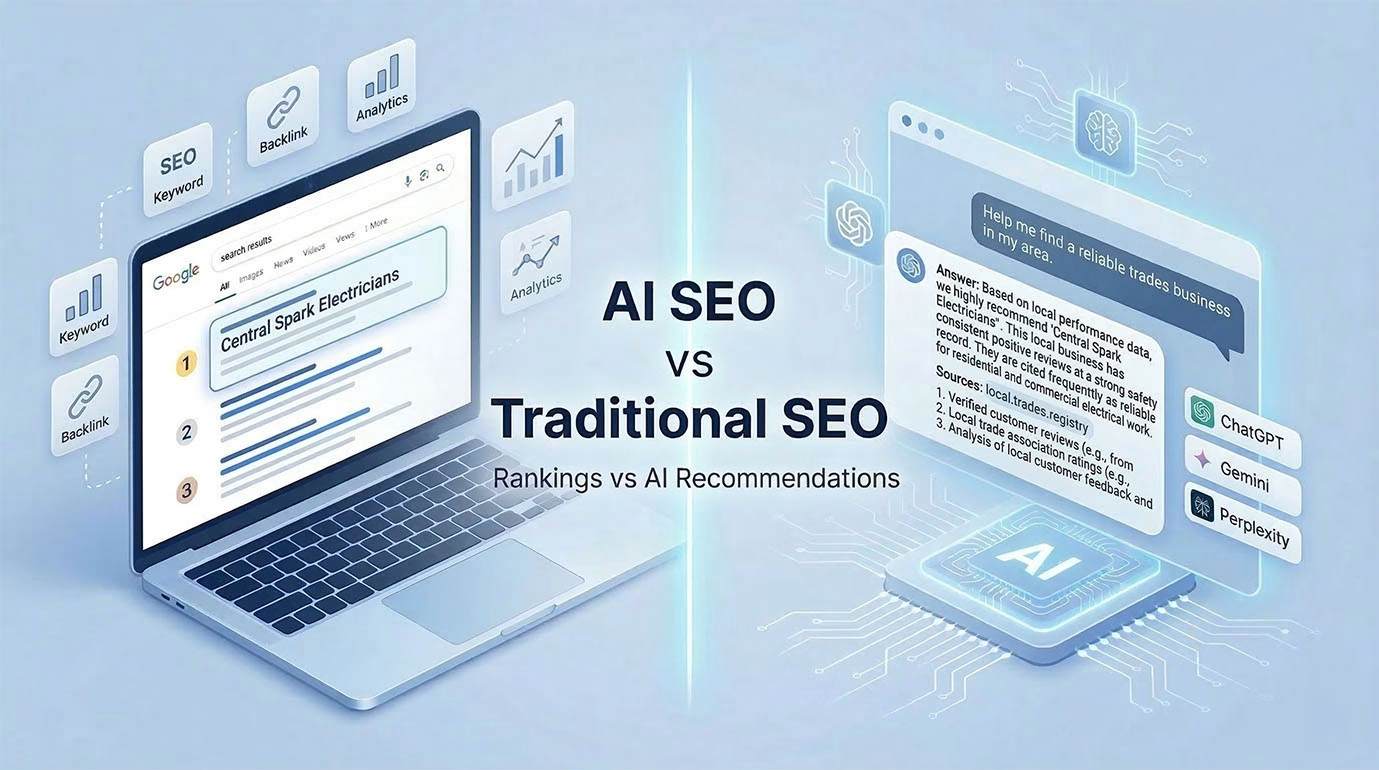
GEO vs Traditional SEO: What’s the Difference?
Traditional SEO and GEO share the same foundation of quality content, authoritative backlinks, and technical site health, but they diverge in their ultimate goal.
| Factor | Traditional SEO | Generative Engine Optimisation (GEO) |
|---|---|---|
| Goal | Rank in a list of search results | Be cited inside the AI-generated answer |
| Output | A blue hyperlink on a results page | A named recommendation or quoted source |
| Format Needed | Keyword-rich pages | Structured, extractable answer blocks |
| Traffic Type | Click-through traffic | Brand visibility and downstream intent |
| Key Signals | Backlinks, authority, keyword match | Clarity, statistics, structured data, freshness |
| Result Time | Weeks to months | Weeks with targeted content updates |

Why GEO Matters for Service Businesses Right Now
According to a 2024 study published at KDD (the ACM Knowledge Discovery and Data Mining conference), businesses that optimised for AI citation saw up to 40% higher visibility in AI-generated answers, simply by citing sources and adding specific statistics to their content.
For service businesses competing in local and national markets, the stakes are high:
- Google AI Overviews now appear in approximately 45% of all Google searches, often pushing traditional results below the fold.
- AI chatbots like Perplexity and ChatGPT typically surface only 3–5 source recommendations per query. If you are not in that shortlist, you are effectively invisible.
- Research by Brightedge found that AI Overviews can reduce organic click-through rates by up to 58% for informational queries. GEO is no longer optional for businesses that depend on online leads.
Businesses looking to implement a structured AI visibility strategy can explore our AI SEO and GEO strategy services.
AI search is rapidly replacing traditional search behaviour
A 2024 study presented at the ACM Knowledge Discovery and Data Mining (KDD) conference found that websites optimised for AI citation, including structured answer blocks, statistics, and authoritative sources, experienced up to a 40% increase in visibility inside AI-generated responses.
This research highlights a fundamental shift in how search engines surface information. Instead of ranking a list of links, AI systems such as ChatGPT, Google Gemini, and Perplexity now synthesise answers and cite only a small number of sources.
For businesses that depend on inbound leads from search, the implication is clear: if your content is not structured to be extractable and authoritative, AI systems will simply cite someone else.
How AI Search Engines Decide What to Recommend
Understanding how AI systems select sources helps you optimise correctly. Each platform uses slightly different signals, but all share common requirements:
1. Extractability
AI systems extract passages, not entire pages. Your content must contain self-contained answer blocks (paragraphs of 40–60 words that directly answer a specific question), without requiring surrounding context to make sense.
2. Authority Signals
Citations, statistics, named expert quotes, and clear author credentials all increase the likelihood of being selected as a source. The Princeton GEO study found that adding authoritative citations to content increased AI visibility by 40%, while adding specific statistics delivered a 37% boost.
3. Freshness
Undated content loses to dated content. AI systems weight recency heavily. Displaying a clear ‘Last updated’ date on every published page is a low-effort, high-impact optimisation.
4. Structured Data
Schema markup (JSON-LD structured data) gives AI systems machine-readable context about your content. Pages with proper FAQ, HowTo, Article, and Organisation schema show 30–40% higher AI visibility, according to analysis by Semrush.
If you’re unsure how visible your business currently is in AI search results, an AI SEO and GEO audit can reveal exactly where you stand.
The GEO Framework for Service Businesses
Optimising for AI citation follows three core pillars:
- Structure your content for extraction: lead every section with a direct answer, use tables for comparisons, and use numbered steps for processes.
- Build authority signals: cite industry research, use specific numbers, include expert attribution with credentials, and keep content current.
- Be present where AI looks, across your own website and third-party sites: industry directories, review platforms like Google Business Profile, and local news coverage.
GEO Checklist for Service Business Pages
| Optimisation Element | Action Required | AI Visibility Impact |
|---|---|---|
| Clear definition paragraph | First paragraph answers the core query directly | High |
| Statistics with sources | Include specific numbers and cite origin data | Very High (+37–40%) |
| FAQ section | Natural-language questions and concise answers | High |
| Schema markup | Add FAQPage, Article, and Organisation schema | High (+30–40%) |
| Last updated date | Visible date on every page | Medium–High |
| Author bio | Named author with credentials | Medium |
| Comparison tables | Structured tables for X vs Y queries | High |
| Google Business Profile | Complete, keyword-rich, regularly updated | High (local queries) |
Frequently Asked Questions
Is GEO the same as AEO (Answer Engine Optimisation)?
GEO and AEO are closely related terms often used interchangeably. AEO typically refers to the older practice of optimising for featured snippets in Google. GEO is the updated, broader term that covers AI-generated responses across all platforms, including ChatGPT, Gemini, and Perplexity, not just Google.
How long does it take GEO to show results?
Unlike traditional SEO, which can take months to move rankings, well-structured GEO content can be indexed and cited by AI platforms within weeks of publication. The fastest gains typically come from adding statistics, FAQ sections, and structured data to existing high-traffic pages.
Can a small service business compete with large brands in AI search?
Yes. AI citation is less correlated with domain authority than traditional search rankings. A well-structured, authoritative page from a local business can outcompete a larger brand if it provides a clearer, more specific, and better-cited answer to the query.
Who handles GEO for service businesses?
Brain Buddy AI specialises in AI SEO and GEO strategy for service businesses across Australia. Our team combines AI-powered content optimisation with deep SEO expertise to help local and national service providers get found in the platforms their customers are already using.
Want to see how visible your business is in AI search?
Brain Buddy AI offers AI SEO and GEO audits with a 24-business-hour turnaround. We analyse your site for schema implementation, content extractability, and AI citation opportunities, then provide a clear strategy tailored to your industry.
Book Your AI SEO & GEO Audit 24-hour audit turnaround • No obligation strategy call